
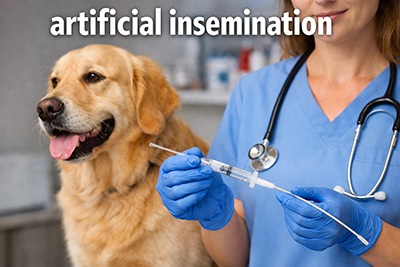
| As with any decision regarding your dog, artificial insemination comes with both advantages and disadvantages. First and foremost, it’s important to note that intravaginal artificial insemination in bitches is classified as a veterinary surgical procedure. As such, it is currently illegal for non-veterinarians to perform it, regardless of any training or qualifications they may hold. As with any aspect of breeding, artificial insemination (AI) carries responsibilities as well as risks. I want to be clear that I have no particular concern about where someone has had AI carried out, whether through a veterinary practice, a breeder, a clinic, or a friend. However, I do feel a duty to inform people that there are genuine risks involved if the procedure is not performed by someone who is properly trained and suitably insured. Vets are currently being actively encouraged to report unregulated fertility clinics, particularly those advertising prohibited or dangerous procedures such as surgical artificial insemination. The British Veterinary Association (BVA) has reinforced calls for urgent action against unregulated dog fertility clinics, highlighting growing concern within the profession about the sharp rise in clinics operating without veterinary involvement and potentially contributing to irresponsible breeding practices. The BVA is urging owners to think carefully before using such services. It is also important to address some common misconceptions. Despite what some breeders are told by certain fertility clinics, a bitch should not be scanned any earlier following AI than she would be after a natural mating. A pregnancy is no further advanced at 21 days post-AI than it would be after natural service. In my view, it is unfair to advise breeders to scan early and then ask them to return a week later. This not only wastes time and money, but can create false hope. A viable pregnancy should be confirmed by the presence of a detectable heartbeat, which is often difficult to reliably visualise before 28 days. From my experience, and based on the bitches I personally scan, the success rate of AI is approximately 30%. This figure is influenced by several factors, particularly the skill of the person performing the procedure and the accuracy of progesterone testing beforehand. Unfortunately, only around half of the bitches I scan following AI have had progesterone levels properly tested prior to insemination. Instead, owners are often told that the bitch is “ready now” and reassured that timing does not matter because sperm can survive for up to seven days. While sperm longevity is a factor, precise timing remains critical for success. It is essential to ensure that whoever performs an AI procedure is appropriately trained and fully insured. Having personally seen a case where a bitch suffered a ruptured bladder during the procedure, I can say with certainty that things can, and do, go wrong. READ MORE HERE. Old “rules of thumb”, such as breeding between days 10–14, simply do not work reliably in every case. The length of standing heat (receptivity) varies greatly between bitches, and the optimal time to breed can occur before, during, or even after visible standing heat. Vaginal cytology (smears) can be useful as a rough guide, particularly to indicate when to begin insemination for a natural mating (live AI). However, they are often not accurate enough on their own when using fresh chilled or frozen-thawed semen, where precise timing is critical. The most accurate method for correctly timing insemination is measuring serum progesterone levels via a blood test (blood must be taken by a vet). During oestrus:
After ovulation, eggs require approximately 48 hours to mature before they are capable of being fertilised. Once mature, they remain viable for around 48 hours. Therefore:
Accurate progesterone testing significantly improves the chances of success by ensuring insemination occurs within this narrow window. Why breeders choose artificial inseminationThere are several reasons breeders may turn to artificial insemination (AI): Availability of the studAn in-demand stud’s availability does not always align with a bitch’s heat cycle. Coordinating schedules can be difficult. AI allows insemination to take place precisely when the bitch’s body is most receptive. Geographic distanceAlthough travel is easier than ever, transporting a bitch hundreds or even thousands of miles can be expensive, stressful, and time-consuming. Semen can be chilled and shipped overnight for next-day use, or frozen and stored for future breeding. When a stud can no longer breed naturallyAI may also be appropriate if a stud has been injured or is physically unable to mount. Collecting and preserving semen allows his bloodline to continue after retirement or death. The procedure and semen handlingOnce collected, semen can be drawn into a long plastic or glass insemination catheter and deposited as close to the cervix as possible. In large breeds, this may be several inches internally.
While AI is performed by both veterinarians and private individuals, it remains a relatively newer and more tightly scrutinised practice within the UK canine world.
|
 |
 |
I also provide a Pedigree Certificate printing service (any breed)
Please find more details on my Breed website


©Site designed and maintained by Julie Growcott www.collielife.com